
Greyhound Racing Fixtures Tonight — Full UK Schedule and Meeting Guide
 Available in US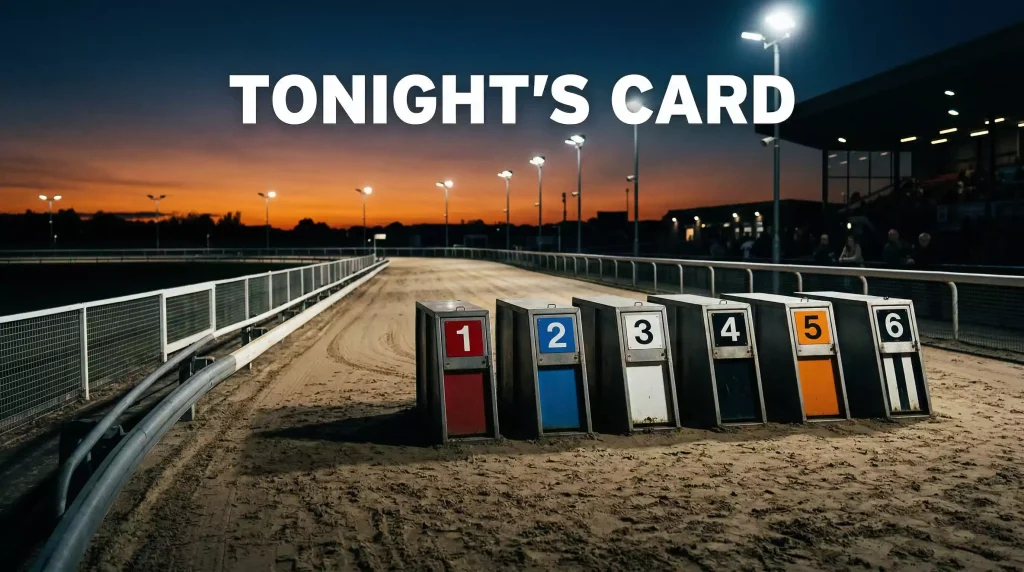
This guide explains how the UK greyhound fixture list is built, what a typical evening meeting looks like, how evening cards differ from the daytime programme, and where to watch or follow tonight’s racing live. Whether you are planning to visit a track, settling in front of RPGTV, or checking the schedule before placing a bet in your local shop, the fixture list is where it all starts. Think of tonight’s card as the daily edition of a publication that runs every day of the year — same format, different content, always delivered on time.
Watching them is covered in racing on TV tonight.
How the UK Greyhound Schedule Is Built
The daily fixture list does not simply emerge from each stadium booking its own races. It is centrally co-ordinated, primarily through two media rights organisations: SIS (Sports Information Services) and The Racing Partnership. Between them, these companies hold the broadcast and data rights for licensed greyhound meetings in the UK, and they construct a schedule that serves two overlapping audiences — trackside racegoers and off-course bettors watching through bookmaker feeds.
SIS is the dominant force. Its greyhound schedule delivers a minimum of forty-two fixtures per week, structured as two meetings running simultaneously in the morning, two in the afternoon, and two in the evening, with twelve races per fixture. The schedule is designed to provide continuous racing content from late morning through to the final evening race, ensuring that betting shops and online operators always have a live greyhound meeting available for their customers. SIS holds long-term contracts with major bookmakers including bet365, William Hill, Paddy Power, and Betfred, which means the schedule is built with commercial broadcasting in mind as much as sporting considerations.
“In formulating our streamlined new schedule for 2026, we were focused on delivering for greyhound tracks owned by greyhound people with a shared passion for the sport,” said Paul Witten, Managing Director of SIS. “We believe our approach is sensible, sustainable, and positive for the industry.” Witten’s emphasis on sustainability reflects a tension that runs through the sport: tracks need fixtures to generate income, but running too many races can strain dog welfare, trainer capacity, and the quality of the cards.
The Racing Partnership provides a second layer of fixtures, adding races from tracks not covered by the SIS deal. When both organisations’ schedules are combined, the total number of weekly meetings can reach as many as seventy-four, with nearly six thousand individual dogs running across the country every week. That is the BAGS system in full flow — Bookmakers’ Afternoon Greyhound Service, a name that undersells its scope since it covers morning and evening meetings too.
For the person checking tonight’s fixtures, what this means in practice is that the schedule is available well in advance. SIS publishes its meeting roster days ahead, and results sites like Sporting Life, Timeform, and Racing Post display which tracks are running on any given evening. The system is designed to be predictable: the same tracks tend to race on the same nights each week, with variations only for special events, abandonments, or calendar adjustments.
What to Expect From Tonight’s Meetings
A typical evening meeting at a UK greyhound stadium follows a reliable pattern. The first race usually goes off between 18:27 and 19:11, depending on the track and whether the meeting is on the SIS or Racing Partnership schedule. Races are spaced roughly fifteen minutes apart, which gives time for the dogs to be paraded, loaded into traps, and run, plus a short interval for results to be confirmed and the next race to be prepared.
Twelve races per meeting is the standard. That gives you about three hours of racing from the first trap to the last, finishing somewhere around 21:15 to 21:45. The races themselves are short — a 480-metre race takes under thirty seconds — so the evening is mostly made up of intervals, anticipation, and the rituals that go with each race: studying the racecard, watching the parade, placing a bet, watching the traps spring open.
On a standard weeknight, two evening meetings will run simultaneously at different tracks. The pairing varies — you might get Romford and Sheffield, or Nottingham and Sunderland — but the scheduling ensures that races at the two venues are staggered so they do not start at exactly the same time. This staggering is deliberate: it means that SIS can broadcast one race after another without dead air, and punters in betting shops get a near-continuous flow of live action through the evening.
The composition of tonight’s card will depend on the track’s grading allocation. Most races are graded — A1 through A11, matching dogs of similar ability — with the occasional open race or special category event (puppy, veteran, maiden) mixed in. Higher-profile tracks like Romford and Nottingham tend to feature stronger gradings and the odd open event; smaller BAGS venues lean toward the middle grades that keep the fixture functional and competitive without requiring the very best dogs.
Evening meetings also draw the largest trackside audiences. The daytime cards are primarily for the off-course betting market, with sparse attendance at the stadium itself. Evenings are when families, groups, and regulars turn up. For tracks that have invested in hospitality — restaurant packages, bars with track views, private boxes — the evening fixture is the commercial heartbeat of the operation.
The race intervals deserve attention if you are planning to bet across the card. With roughly fifteen minutes between races and two meetings running simultaneously, you could have a race going off at one track while the previous race’s results are still being processed at the other. This is by design: the staggered scheduling means that a punter in a betting shop sees almost continuous action, while someone following from home can check results from one venue and assess the next race at another without dead time. It is an efficient system, and understanding the rhythm of the evening — when each race is due off, how long results take to post — makes following tonight’s fixtures considerably less frantic.
Morning and Afternoon Cards — How They Differ
Evening meetings get the most attention, but they represent only a third of the daily output. The SIS schedule runs two morning meetings and two afternoon meetings alongside the evening pair, and The Racing Partnership adds further cards on top of that. This daytime programme is the backbone of BAGS racing and exists primarily to serve the off-course betting market.
Morning cards typically start around 10:30 and wrap up by early afternoon. Afternoon meetings begin around 13:30 to 14:00 and finish before the evening programme starts. The same twelve-race format applies, and the same tracks rotate through the schedule, though some venues are more associated with daytime racing than others. Smaller tracks with lower overheads and less hospitality infrastructure often fill the morning and afternoon slots, while the bigger stadiums save their evening fixtures for the audiences that will actually come through the gates.
The racing itself is identical in format — six dogs, same grading system, same distances — but the atmosphere is entirely different. Daytime cards at most tracks run to near-empty grandstands. The dogs race, the results are recorded, the SIS feed carries the pictures to betting shops and online streams, and the meeting proceeds with minimal fanfare. This is industrial-scale content production for a betting market that demands a constant supply of live events throughout the day.
For bettors, there are practical differences. Liquidity tends to be lower on morning cards, which means exchange prices (BSPs) may be less reliable, and the range of form data available may be thinner for dogs running in lower grades at quieter venues. The standard of racing is not necessarily worse — grading ensures competitive fields regardless of the time slot — but the market around each race is shallower. For anyone primarily interested in attending live racing, morning and afternoon cards are not the right target — you want the evening meeting, where the experience is built around spectators rather than cameras.
Where to Watch Tonight’s Fixtures
There are more ways to watch live greyhound racing in 2026 than at any previous point in the sport’s history, even if most people still encounter it through one of three channels: television, betting shops, or online streams.
RPGTV (Racing Post Greyhound TV) is the easiest free option. Available on Freeview channel 261, it broadcasts selected evening and daytime meetings with live commentary and analysis. The coverage is straightforward — camera on the track, a presenter, the form — and it is the closest thing the sport has to a dedicated terrestrial channel. You do not need a subscription or a betting account to watch.
Sky Sports Racing offers broader and more polished coverage, but it requires a Sky subscription or access through a compatible streaming service. It covers both greyhound and horse racing, and during the evening it will often carry at least one live greyhound meeting alongside its equine programming. If you already have Sky, it is a natural complement to RPGTV.
For the estimated 5,825 licensed betting shops across the UK, SIS feeds provide the primary greyhound content. Walk into any major bookmaker — Betfred, William Hill, Coral, Ladbrokes — and the screens on the wall will cycle through live greyhound and horse racing meetings throughout the day. The SIS feed is tailored for the betting environment: quick turnarounds between races, odds overlays, and results displayed within seconds of the finish. You do not choose which meeting to watch; the schedule determines what is on screen at any given moment.
Online, several bookmakers stream live greyhound racing to logged-in customers, sometimes requiring a funded account or a placed bet to access the stream. bet365, Betfred, and Paddy Power are among those that offer live greyhound pictures. The quality varies, but the convenience is hard to beat if you want to follow tonight’s card from a phone or laptop without turning on the television. At The Races also hosts replays and some live content on its website and app.
If none of these appeal, you can always follow results without watching a race. Timeform, Sporting Life, and Racing Post all publish live results as each race finishes, with full data — winner, times, SPs, dividends — available within minutes of the off. For many regular punters, this text-based approach is faster and more informative than watching a thirty-second race on a grainy stream.
Weekly Fixture Patterns — When Do Tracks Race?
One of the more useful things to know about UK greyhound racing is that the weekly schedule is largely predictable. Most tracks have set race nights that repeat week after week, with only occasional variation for special events, bank holidays, or calendar reshuffles.
Romford is one of the most prolific venues, running Friday and Saturday evening meetings alongside multiple daytime BAGS cards during the week. If you want greyhound racing in the south-east, Romford is almost always available. Sheffield’s Owlerton Stadium follows a Tuesday, Thursday, and Saturday pattern under Arena Racing Company management, making it the dominant northern track for regular evening fixtures. Newcastle and Sunderland share the north-east between them, typically running on different nights so that the region has coverage multiple times per week.
Nottingham races regularly on weekday evenings and has become particularly associated with its weekend and holiday fixtures, including the high-profile Boxing Day meeting that drew over a thousand spectators in 2026. Monmore Green in Wolverhampton takes Monday and Friday evening slots, while Dunstall Park — the sport’s newest venue — is establishing its own fixture identity alongside the existing Midlands calendar. In the south, Brighton and Hove and Central Park fill evening slots on their allocated nights, and Poole offers the south-west’s only option.
Arena Racing Company, which manages several of these venues, reported a 5% increase in attendance across its greyhound stadiums in 2026, suggesting that the regularity of the schedule is helping to build habitual audiences — people who come on the same night each week because they know racing will be on. This is not a new phenomenon in greyhound racing. Going to the dogs on a particular night of the week was a social ritual for decades in working-class communities, and the surviving tracks are consciously trying to rebuild that habit.
For daytime fixtures, the rotation is busier and less predictable to the casual observer, because smaller tracks cycle through morning and afternoon slots to fulfil the SIS and Racing Partnership contracts. The best approach is simply to check the schedule on the day — Sporting Life and Timeform both list the full card with first-race times — rather than trying to memorise which track runs which afternoon.
The full picture is in tonight’s greyhound results.
Cancellations, Abandonments, and Changes
Greyhound meetings can be cancelled or abandoned, and knowing why — and how to check — saves wasted trips and misplaced bets. The most common cause of an abandoned meeting is weather. While greyhound tracks use all-weather sand surfaces that cope with moderate rain, sustained heavy downpours can waterlog even a well-drained circuit. Standing water on the bends creates a safety risk for the dogs, and stewards will call off a meeting if the surface is deemed unfit. Frost is another threat, particularly for early-morning fixtures in winter: a frozen track surface is dangerous and cannot be raced on.
Track damage is rarer but does happen. If the hare mechanism breaks down, or if the running surface develops a problem mid-meeting, individual races may be voided or the remaining card abandoned. This is unusual at well-maintained GBGB-licensed venues, but it is not unknown.
When a meeting is abandoned, the SIS schedule adjusts where possible. If one of the evening’s two meetings falls through, the surviving meeting carries on alone, and punters simply have fewer races to follow. Replacement fixtures are not typically arranged at short notice — the logistics of transporting dogs, allocating trap draws, and briefing track staff make same-day replacements impractical.
Checking whether tonight’s fixture is still on is straightforward. SIS and the tracks themselves update status on their websites, and results platforms like Sporting Life flag cancellations prominently. If you are heading to the track in person, a quick check of the stadium’s social media feed or a phone call to the venue will confirm whether racing is going ahead. For betting purposes, cancelled meetings mean all bets on those races are voided and stakes returned — a minor inconvenience but worth knowing if you have placed accumulators across multiple meetings.
Bank holidays and seasonal calendar changes also affect the fixture list. Christmas and Easter bring rearranged schedules, with some tracks hosting special events (Nottingham’s Boxing Day fixture being the most prominent example) and others taking the day off. The summer months occasionally see schedule tweaks to avoid clashes with major horse racing festivals, though greyhound racing generally operates in its own lane and is less affected by the equine calendar than you might expect.
One final point worth noting: the fixture list can also change for positive reasons. When a track hosts an open race or a round of a major competition — the English Greyhound Derby qualifiers, for instance, or the All England Cup heats at Newcastle — the normal graded card is adjusted to accommodate the higher-profile event. These additions are announced in advance and are flagged on racecards, so you will always know whether tonight’s fixture includes something beyond the standard twelve graded races. The schedule, in short, is stable enough to be predictable and flexible enough to accommodate the sport’s showpiece events.
