Greyhound Betting Guide — Strategies, Odds and Market Types Explained
 Available in US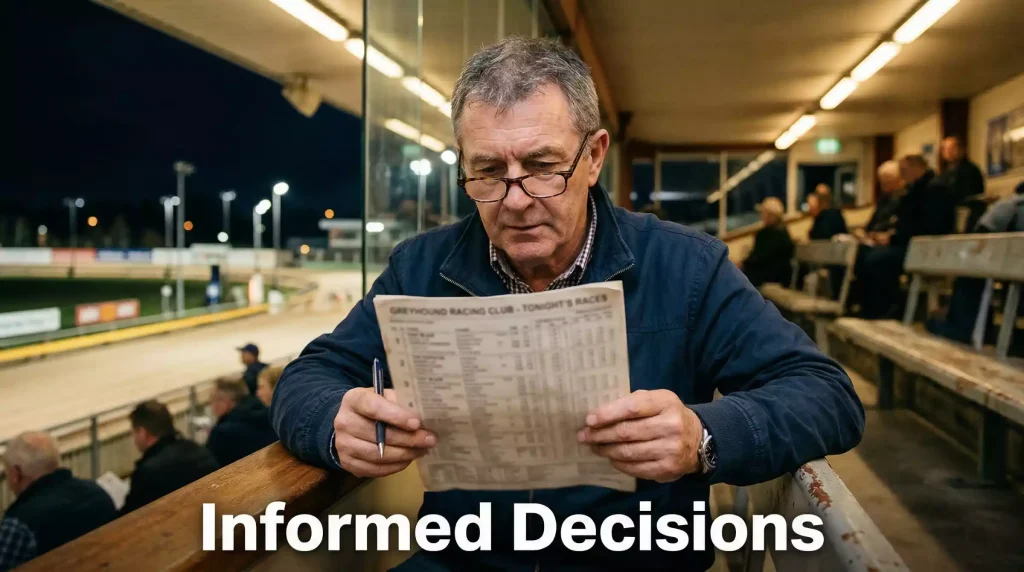
This guide covers the core bet types available on greyhound racing, explains how odds are formed and what drives price movements, walks through the basics of form analysis and trap draw strategy, and finishes with a plain-spoken section on staking and bankroll management. The aim throughout is to help you make informed decisions rather than lucky guesses. There are no guaranteed systems here, no secret angles, and no promises — just a framework for understanding the market you are betting into.
The exotic markets are explained in forecast and tricast.
Bet Types — Win, Each-Way, Forecast, Tricast
Greyhound betting offers fewer market types than horse racing but more than enough to keep things interesting. The core options break down as follows.
A win bet is the simplest form: pick the dog you think will finish first, and if it does, you collect at the agreed odds. If it finishes second or worse, you lose your stake. That is it. No complications, no partial returns, no ambiguity. Win betting is where most people start, and for many experienced punters it remains the bread and butter — there is nothing wrong with simplicity if you are applying it to a well-researched selection.
An each-way bet splits your stake into two halves: one on the dog to win and one on the dog to place (usually first or second in a six-runner field). If the dog wins, you collect on both parts. If it finishes second, you lose the win portion but collect the place portion at a fraction of the odds — typically one quarter of the win price for greyhounds. Each-way betting suits situations where you fancy a dog to be competitive but are not confident enough to commit entirely to a win bet. The trade-off is that you are staking double: a £5 each-way bet costs £10.
A forecast requires you to name the first two finishers in exact order. It is harder than a win bet but the returns are proportionally larger. The payout is calculated after the race using the Computer Straight Forecast (CSF) formula, which takes into account the starting prices of the placed dogs. A reverse forecast covers both possible orders (A-then-B or B-then-A) and costs twice the stake. Forecast betting works best in races where you have a strong view about two dogs but are less certain which will beat the other.
A tricast goes one step further: name the first three finishers in exact order. The mathematical difficulty is obvious — with six runners, there are 120 possible first-second-third combinations — and the dividends reflect that difficulty. A combination tricast covers all six orderings of three selected dogs and costs six times the unit stake, which removes the need to pick the exact sequence but obviously reduces the effective return per pound invested.
Beyond these core types, greyhound punters can place accumulators (linking selections from multiple races into a single bet, where all must win), doubles and trebles (simpler versions of the same idea), and match bets at some bookmakers (picking which of two dogs will finish ahead of the other, regardless of their overall position). But the four types above — win, each-way, forecast, and tricast — account for the vast majority of greyhound betting volume in the UK.
How Greyhound Odds Work — SP, BSP, and Board Prices
Greyhound odds are set by the interplay between bookmaker pricing, on-course markets, and exchange activity. If you place a bet early — hours or even days before a race — you take a fixed price that will not change regardless of what happens in the market before the off. If you take SP (starting price), you accept whatever the officially returned price is at the moment the traps open. And if you bet on an exchange like Betfair, you are matched against another punter rather than a bookmaker, and the price is determined by supply and demand in the exchange market.
Board prices — the odds displayed by bookmakers before and during the day of racing — are where most casual punters engage. A dog might be priced at 5/2 in the morning, drift to 7/2 by the afternoon as money comes for other runners, or shorten to 2/1 if late support arrives. These movements reflect the weight of money: when more bets are placed on a dog, its price shortens; when money goes elsewhere, it drifts. In a market as compressed as greyhound racing — six runners, short odds ranges, modest liquidity — price movements can be sharp and sudden.
The SP is the settlement price for anyone who did not take a fixed early price. It is returned by the on-course market after the race, reflecting the consensus of prices offered by trackside bookmakers at the moment of the off. The declining number of on-course layers at greyhound stadiums has raised questions about the reliability of SPs, particularly at smaller tracks where the on-course market may be thin.
Betfair Starting Price (BSP) offers an alternative derived from exchange activity. It is often different from the SP — sometimes higher, sometimes lower — depending on how much money was traded on the exchange. Data from the Gambling Commission indicates that greyhound betting turnover has declined by 23% in real terms over three years, and that contraction affects exchange liquidity directly. Thinner pools mean less reliable BSPs, particularly on morning BAGS cards where exchange interest is lightest.
For practical purposes, the choice between taking an early price and waiting for SP comes down to how confident you are in your selection and whether you think the price will move against you. If you spot a dog at 4/1 that you believe should be 2/1, taking the early price locks in value. If you are less sure, SP removes the risk of being stuck at a short price if the dog drifts. Neither approach is inherently better — it depends on the situation and your read of the market.
The full picture is in tonight’s greyhound results.
Using Form to Find Value
Form analysis in greyhound racing starts with the same question it does in any sport: what has this runner done recently, and does it suggest it will perform well tonight? The difference is that greyhound form is compressed — dogs race frequently, sometimes twice a week, and form can shift rapidly as fitness, confidence, and grading adjustments take effect.
The most basic form indicator is recent finishing positions. A dog showing 1-2-1-3 in its last four runs is clearly in good form. One showing 5-6-4-6 is struggling. But positions alone are misleading without context. A dog that finished fourth from Trap 6 at a track with a strong inside bias may have run a better race than its position suggests. A dog that won from Trap 1 on a track that heavily favours the inside box may have been flattered by the draw.
Finishing times add a second layer. Comparing a dog’s recent times at the same track, over the same distance, on the same going, gives you a sense of whether it is running faster or slower than its rivals. The key is consistency: a dog that clocks similar times race after race is reliable; one whose times fluctuate widely is less predictable. Sectional data — where available — reveals even more, showing whether a dog’s strengths lie in early pace or finishing speed.
Trap draw is the third critical variable. Greyhound form is inseparable from the starting position. A dog that excels from Trap 1 may struggle from Trap 5, and vice versa. Looking at a dog’s record from its drawn trap, rather than its overall record, gives you a more precise picture. Many experienced punters will not bet on a dog that is running from an unfamiliar or unfavourable trap position, regardless of how good its recent form looks.
Weight changes, trainer form, and going preference round out the picture. A dog carrying a couple of kilograms more than its last run may have been rested or may be carrying condition that slows it down. Trainers go through hot and cold spells, and some consistently prepare their dogs better for certain tracks. And some dogs simply run better on a dry surface than a wet one, or the other way around. None of these factors is decisive on its own, but together they form a composite assessment that the market may or may not have priced correctly — and that gap between your assessment and the market’s is where value lives.
Trap Draw and Its Impact on Betting
If form is the foundation of greyhound betting, the trap draw is the variable that most frequently upsets it. Every race begins with six dogs in numbered boxes, and the position of that box on the starting line determines how much ground each dog covers on the first bend — the most congested and influential phase of any race.
Aggregate data across UK tracks shows that Trap 1 wins approximately 18 to 19% of races, compared to a theoretical fair share of 16.6% (one in six). The advantage comes from the protected inside rail: the dog in Trap 1 only needs to worry about pressure from one side and has the shortest path to the first bend. Over thousands of races, that edge compounds into a measurable bias.
But the aggregate masks huge variation between tracks. At tight, sharp-turning stadiums like Romford, the inside advantage is pronounced. At tracks with wider bends and longer runs to the first turn, outside runners have more time to establish a position and the bias flattens or even reverses. Some tracks consistently favour Trap 6 runners, particularly in longer-distance races where the pack has more time to sort itself out before the first bend.
For betting purposes, trap bias data is most useful when combined with individual dog form. If you know that a particular track favours Trap 1, and tonight’s Trap 1 runner also has strong recent form and a running style that suits the inside, you have a compound case. Conversely, if a dog with excellent form is drawn in a trap that historically underperforms at that track, you might decide the price does not compensate for the draw disadvantage — or you might identify the market as having overreacted to the draw, offering value on an unfashionable trap position.
The practical approach is to treat trap bias as one factor among several rather than a standalone system. Backing Trap 1 blindly in every race will not make you money — the overround in bookmaker pricing already accounts for known biases. But using trap data to refine your selections, to decide between two closely matched dogs, or to spot situations where the draw has been underpriced or overpriced by the market — that is where it earns its keep.
Betting on BAGS Races — Volume and Liquidity
The majority of greyhound racing in the UK falls under the BAGS umbrella — Bookmakers’ Afternoon Greyhound Service, a name that significantly understates its reach. In its expanded format, operating since 2018, the BAGS system produces up to seventy-four meetings per week with nearly six thousand dogs running across the country. This is the engine of daily greyhound racing, and for bettors, it is the environment you are operating in most of the time.
BAGS races are broadcast via SIS and The Racing Partnership to bookmaker outlets and online platforms. SIS alone delivers a minimum of forty-two fixtures per week and holds long-term contracts with bet365, William Hill, Paddy Power, and Betfred. That commercial infrastructure means BAGS racing is available in every major betting shop in the country and on every significant online sportsbook — accessibility is not an issue.
Liquidity, however, varies. Evening BAGS meetings at well-known tracks attract reasonable market depth: bookmakers price the races competitively, exchanges see decent volumes, and the form data is detailed enough to support analysis. Morning and early-afternoon cards at smaller venues are thinner. Fewer punters engage, exchange pools are smaller, and the odds may be less reflective of true probability. This does not make those races unbettable, but it does mean you should be more cautious about the prices you accept and more aware that the market may not have been stress-tested by significant money.
Premier events — the English Greyhound Derby, the Oaks, the Champion Stakes — sit outside the BAGS framework and attract significantly more market attention. These races are priced like horse racing features, with substantial ante-post markets, detailed previews, and deep exchange liquidity. For most bettors, though, BAGS is the daily reality, and understanding that the market varies in quality from fixture to fixture is an important part of operating within it.
Staking, Bankroll, and Responsible Gambling
The frequency of greyhound racing makes staking discipline more important here than in almost any other betting sport. With twelve races per meeting and multiple meetings per day, it is possible to place dozens of bets in a single evening — and that volume amplifies any weaknesses in your approach. A flawed staking plan that might cost you a moderate amount over a Saturday afternoon’s horse racing can drain a bankroll in a single evening of dogs if you are not careful.
The most common approach among disciplined bettors is flat staking: betting the same amount on every selection regardless of confidence. It is not the most sophisticated method, but it removes the emotional temptation to chase losses by increasing stakes after a losing run. If your typical bet is £5, it stays £5 whether you have just won three in a row or lost five. Over hundreds of bets, this consistency smooths out variance and gives you a clearer picture of whether your selection method is actually profitable.
Percentage-of-bankroll staking is a refinement: instead of a fixed amount, you bet a fixed percentage (often 1% to 3%) of your current bankroll on each selection. This naturally adjusts your stakes downward during losing streaks and upward during winning ones, which protects against ruin while allowing your betting to grow with your bankroll. It requires more discipline than flat staking — recalculating your stake before each bet — but it is the preferred approach for most serious bettors.
The broader context matters here. The UK’s total gross gambling yield reached £16.8 billion in the year to March 2026, a 7.3% increase on the prior year. Greyhound racing is a small fraction of that total, but the number illustrates the scale of the market and the commercial machinery designed to keep you betting. Bookmakers are not charities. Their prices include a built-in margin (the overround), and their products are designed to encourage repeat engagement. Being aware of that — really aware, not just intellectually — is the first step toward betting in a way you can sustain.
“Since the GBGB began operating in 2009, there’s been no increase in the percentage that’s being paid, which is 0.6% of greyhound turnover,” said Mark Bird, Chief Executive of the GBGB, in a discussion about the sport’s voluntary levy. “What that has meant is that the amount year-by-year has steadily gone down. More than three quarters of the money we get from that levy is put into welfare and integrity.” Bird’s point is about industry funding, but it also underlines a broader truth: the money that flows through greyhound betting sustains not just bookmaker profits but the sport itself — its tracks, its welfare programmes, its regulatory structures. Betting responsibly is not just about protecting your own finances; it is about engaging with a system that needs sustainable participation rather than reckless spending.
Set a budget before you start. Decide what you can afford to lose — genuinely afford, not optimistically afford — and do not exceed it. Use the deposit limits, loss limits, and reality-check tools that every licensed UK bookmaker is required to offer. If you find yourself chasing losses, increasing stakes to recover, or betting on races you have not analysed simply because they are about to start, step back. The dogs will still be running tomorrow.
