Dunstall Park Greyhound Stadium — The UK’s Newest Track and Its First Year
 Available in US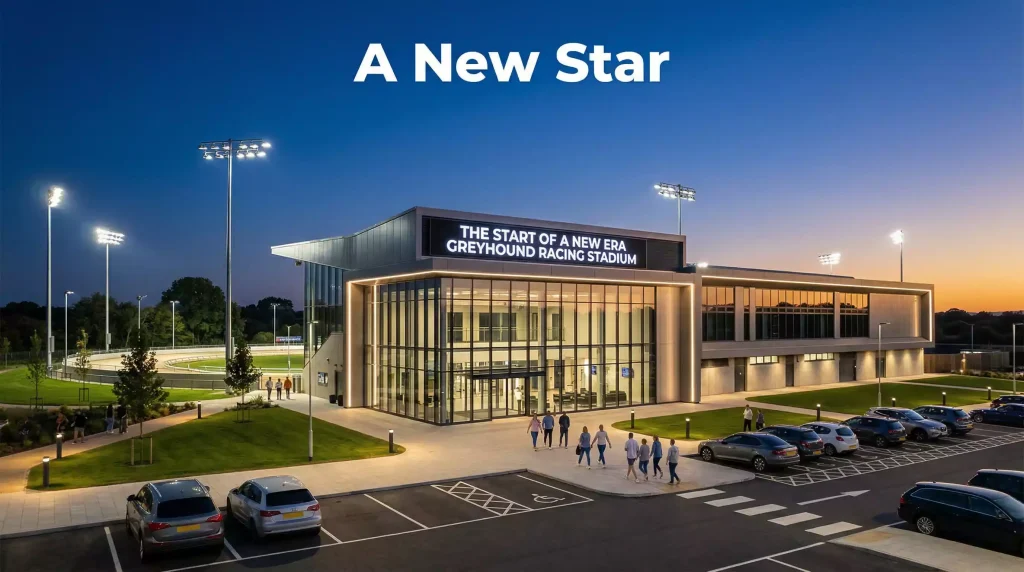
Dunstall Park greyhound stadium is a new chapter in a sport that has not had many new chapters in recent decades. Situated in Wolverhampton, it is the first purpose-built greyhound stadium to open in the UK in more than ten years — a fact that says as much about the sport’s long contraction as it does about the ambition behind this particular project. While tracks have been closing at a steady rate since the post-war peak, Dunstall Park opened its gates and asked a straightforward question: can a modern facility reverse the direction of travel?
The stadium shares the Dunstall Park site with Wolverhampton Racecourse, giving it an immediate infrastructure advantage that standalone greyhound venues have rarely enjoyed. It is operated by Arena Racing Company, the largest greyhound and horse racing operator in the UK, and was designed from the outset to host both regular BAGS fixtures and the flagship events that previously called Perry Barr home. The English Greyhound Derby, the Oaks, and other Premier Greyhound Racing competitions have all been relocated to this venue.
Every other venue is covered in the tracks guide.
Why Dunstall Park Was Built — Perry Barr’s Closure and the Need for a Replacement
The opening of Dunstall Park in 2026 was directly linked to the closure of Perry Barr, Birmingham’s historic greyhound stadium that had housed the English Greyhound Derby for decades. Perry Barr’s site was earmarked for redevelopment, and the sport needed a new home for its flagship events — one that could absorb the Derby, maintain the Midlands’ position on the racing map, and provide facilities that matched the expectations of a modern audience.
The timing was loaded with symbolism. 2026 marked the centenary of greyhound racing in the UK and Ireland, and the year produced a stark split screen: Dunstall Park opening as the sport’s newest venue while Crayford, Perry Barr, and Swindon all closed permanently. The net loss of two tracks reduced the licensed circuit to 18 GBGB stadiums. Dunstall Park’s arrival softened the blow — without it, the centenary would have been defined entirely by closures rather than by any forward momentum.
ARC’s decision to build at Dunstall Park rather than retrofit an existing venue reflected a calculation about what the sport needs to attract a twenty-first-century audience. A new-build allows modern sightlines, contemporary catering facilities, and a layout designed for both on-course spectators and the broadcast infrastructure that BAGS fixtures and SIS coverage require. Perry Barr, for all its history, was an ageing stadium with limitations that no amount of renovation could fully address. Dunstall Park started with a blank canvas, and the design choices made on that canvas will shape how the sport presents itself for years to come.
Dunstall Park’s First Year — Attendance and Events
The early numbers from Dunstall Park have been encouraging. The Premier Greyhound Racing Oaks final, staged at Dunstall Park in 2026, drew 324 per cent more spectators than the same event had attracted at Perry Barr the previous year. That figure needs context — Perry Barr’s attendance had been declining for years, so the comparison benefits from a low baseline — but a three-fold increase for the same event at a new venue is a strong opening statement regardless of the starting point.
The Oaks was not the only event to benefit from the move. The English Greyhound Derby’s relocation to Dunstall Park brought the sport’s most prestigious competition to a venue equipped to showcase it properly: better facilities for on-course spectators, improved broadcast setup for television and streaming, and a track built to modern standards. The Derby final remains the pinnacle of the UK greyhound calendar, and its presentation at Dunstall Park set a standard that the previous venue could no longer match.
Beyond the flagship events, Dunstall Park’s regular BAGS fixtures provide the baseline of weekly racing that any stadium needs to remain commercially viable. The standard 12-race evening card, slotted into the SIS schedule alongside meetings at other tracks, generates the betting turnover and fixture fees that sustain the stadium’s operations between the high-profile events. Early reports suggest that the regular cards have attracted solid entries and respectable on-course attendance, though the true test will be whether those numbers hold once the novelty factor fades.
The wider context is set out in tonight’s greyhound results.
The Stadium — What Makes Dunstall Park Different
Dunstall Park’s design reflects lessons learned from decades of greyhound stadium operation elsewhere. The track itself is built to modern specifications: a well-drained sand surface, adequate lighting for evening racing and television coverage, and a layout that balances competitive racing with spectator sightlines. The co-location with Wolverhampton Racecourse provides shared infrastructure — parking, access roads, hospitality facilities — that a standalone greyhound stadium would struggle to justify commercially.
The track geometry has been designed to produce fair racing across multiple distances. Unlike older stadiums where the track dimensions were dictated by the available plot of land, Dunstall Park’s circuit was planned from scratch with competitive balance in mind: bends wide enough to reduce crowding and interference, straights long enough to allow dogs to separate on pace, and starting positions calibrated to give each trap a reasonable chance at the first turn. Whether the track produces the kind of trap bias patterns seen at older venues will only become clear as results accumulate over a full season, but the design intent is to create a circuit where form and ability matter more than the luck of the draw.
The grandstand and viewing areas are designed for comfort rather than mere functionality. Covered seating, clear views of the entire circuit, and accessible layouts make the venue suitable for a broader audience than the traditional hardcore of greyhound regulars. The catering and hospitality offer is a step up from what most existing tracks provide, reflecting ARC’s understanding that modern audiences expect more from a night out than a betting slip and a cup of tea.
The location in Wolverhampton also places Dunstall Park within easy reach of Birmingham — the city that Perry Barr served for nearly a century. The journey between the two cities is short enough that regular Perry Barr attendees can make the switch without a fundamental change to their evening routine. Whether they will, in sufficient numbers and with sufficient regularity, is the commercial question that Dunstall Park’s viability ultimately rests on.
Whether Dunstall Park becomes a permanent fixture or a bold experiment that struggles to sustain itself will depend on factors beyond the quality of the building. Attendance trends, betting turnover, the health of the BAGS schedule, and the broader political and regulatory environment will all play a role. But as a statement of intent — that the sport can still invest, still build, and still attract an audience — Dunstall Park’s first year has been a new chapter worth reading.
