
Greyhound Racecards Explained — How to Read a Race Card Before the Off
Best Greyhound Betting Sites – Bet on Greyhounds in 2026
Loading...
A greyhound racecard is the document you study before the traps open. It contains everything you need to assess the six runners in a race — name, trainer, weight, recent form, trap draw, grade, and best time — presented in a standardised format that looks dense at first glance but becomes second nature once you know what each column means.
If the results table tells you what happened after the race, the racecard tells you what to expect before it. It is the pre-match team sheet, the starting grid, and the form guide rolled into one. Every licensed GBGB track in the UK publishes racecards ahead of each meeting, and every serious bettor reads them. The casual punter who picks a dog by jacket colour is gambling. The punter who reads the racecard is making an informed decision — and the difference shows up in the long run.
This guide explains every element of a greyhound racecard, how to decode the shorthand, and how to translate what the card tells you into a practical assessment of tonight’s runners.
What Every Column on a Racecard Means
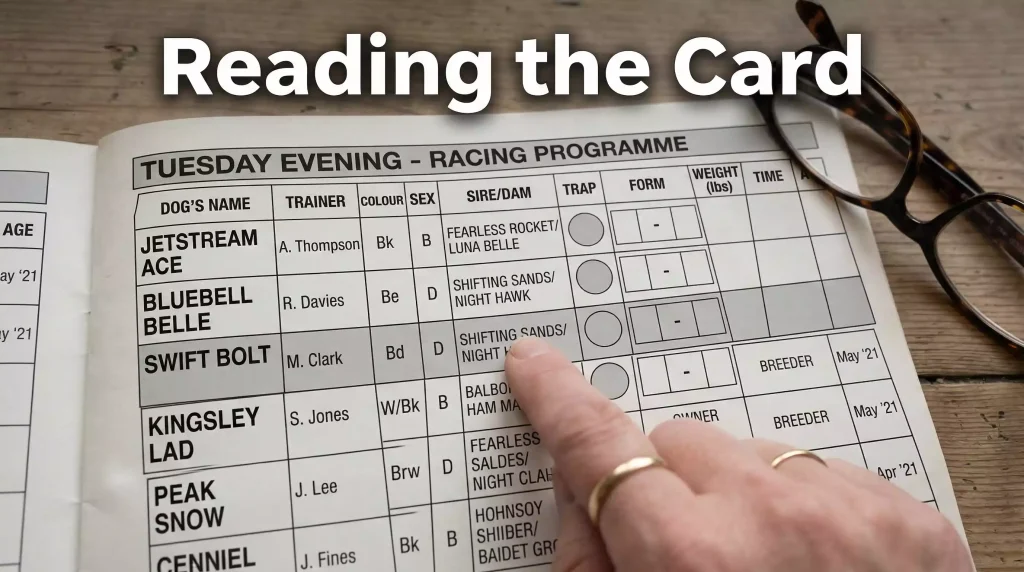
A standard greyhound racecard presents each runner as a row, with columns for the key data points. The exact layout varies between platforms — Timeform, Racing Post, Sporting Life, and individual stadium sites all have their own presentation — but the underlying information is consistent. Here is what you will find.
Trap number and colour. Each dog is assigned to one of six traps, numbered 1 through 6. The trap determines the starting position: Trap 1 is the inside box, Trap 6 the outside. Each trap number corresponds to a jacket colour — red (1), blue (2), white (3), black (4), orange (5), and striped (6) — which makes the dogs easy to identify during the race. The trap assignment is not random; it is decided by the grading secretary based on the dog’s running style and previous trap preferences, though the degree of accommodation varies.
Dog name and trainer. The dog’s registered name appears alongside the trainer’s name. Knowing the trainer is useful because certain trainers have patterns — some specialise in sprinters, others in stayers, and some have a notably higher strike rate at specific tracks. Over time, recognising trainer patterns adds a layer of analysis that the raw form figures alone do not capture.
Weight. The dog’s racing weight is recorded in kilograms, typically to one decimal place. Weight fluctuations between races can indicate changes in condition: a dog that has dropped half a kilogram since its last run may be sharper, while one that has gained weight may be less quick out of the traps. Small differences matter in a sport where fractions of a second separate the field.
Grade. The race grade — A1 through A11, OR (open race), or special categories like puppy or veteran — tells you the standard of competition. Higher grades (A1, A2) feature faster dogs; lower grades (A7, A8) are for less able runners. The grade also reflects the dog’s recent performance: consistent winners move up, consistent losers move down.
Recent form. A string of numbers representing the dog’s finishing positions in its last several races, typically the most recent six. The form reads left to right, with the most recent run on the right. A form line of 321142 tells you the dog finished third, second, first, first, fourth, and second in its last six outings — a consistent performer that has won twice and placed in most of the others.
Best time. The fastest time the dog has recorded over the relevant distance at this track, adjusted for the going. This number is a ceiling — it shows what the dog is capable of at its peak — and is useful for comparison against the best times of the other runners in the same race.
Comments and notes. Some racecards include brief comments from the form compiler or the trainer, highlighting recent race observations or anticipated running style. These are subjective rather than statistical, but they can flag factors — a tendency to baulk on the first bend, a preference for rail running — that the numbers alone do not reveal.
Decoding Form Figures — 1s, 2s, and What m and w Mean
The form figures on a racecard are a compressed history of the dog’s recent racing career, and reading them fluently is one of the core skills in greyhound betting. The numbers are finishing positions: 1 means the dog won, 2 means second, and so on through to 6. A form line like 111234 describes a dog that won three consecutive races, then finished second, third, and fourth — a pattern that suggests it was in peak form before a gradual decline, possibly due to increased competition after being upgraded in grade.
Letters sometimes appear in the form string alongside the numbers. The most common are “m” (mid-division, a loose shorthand for finishing in the middle of the pack without a specific position being recorded in some formats), “w” (wide — the dog raced wide throughout), and “F” (fell or failed to finish). A “-” or blank space typically indicates a break in racing — the dog had time off between runs, whether for rest, injury recovery, or a change of training schedule. Gaps in the form string are worth noting: a dog returning from a break may need a race or two to sharpen up, and its first run back is often below its true ability.
The volume of form data available on any given evening is substantial. A standard BAGS fixture runs 12 races with six runners each, which means 72 individual form lines to assess in a single meeting — and that is just one track. With SIS coordinating a minimum of 42 fixtures every week, the total volume of form data generated across the UK circuit is enormous. Nobody reads every line. The skill is in knowing which form figures matter most for the specific race you are evaluating, and which can be skimmed.
One common mistake is reading form figures without context. A finishing position of 3 tells you the dog came third, but it does not tell you why. Was it third because it was baulked on the first bend? Because it ran wide throughout? Because the winner was three grades higher and entered the race as a certainty? The form number is the starting point; the race comments from the full results — available after the race — fill in the story. Smart form readers check both: the racecard for the numbers, and yesterday’s results for the narrative.
From Racecard to Bet — A Practical Walkthrough
Translating a racecard into a betting decision involves comparing the six runners across multiple dimensions and identifying which dog has the strongest overall profile for this specific race, at this specific track, over this specific distance.
Start with the trap draw. The racecard shows which trap each dog occupies, and that information gains significance when you apply what is known about trap bias at the venue in question. Across UK tracks as a whole, Trap 1 wins at roughly 18 to 19 per cent — above the theoretical one-in-six baseline — because the inside position offers a shorter path to the first bend and protection from crowding on one side. At tracks with tighter bends, the inside advantage is amplified. At venues with wider geometry, it is reduced. The racecard tells you where the dog is starting; the trap bias data tells you what that starting position is worth.
Next, compare recent form. A dog with a form line of 112211 has been winning and placing consistently — that is form you can trust, assuming the grade has remained stable. If the dog has recently been upgraded from A5 to A3, the same form figures carry less certainty, because it is now racing against faster opponents. The racecard shows both the form and the grade, and you need to read them together.
Weight trends offer a subtler layer. Compare each dog’s current weight against its weight at its last two or three runs. A consistent weight suggests stable condition. A noticeable drop — half a kilogram or more — might indicate a dog that has been trained hard and could be sharper. A noticeable gain might suggest the opposite. These signals are not definitive, but they add texture to the picture, and they cost nothing to check — the data is right there on the card.
Finally, factor in the best time. If two dogs have similar recent form and comparable trap draws, but one has a best time two tenths of a second quicker over this distance at this track, that dog has demonstrated a higher performance ceiling. It may not hit that ceiling tonight, but the capacity is there. Before the traps open, the racecard has already told you most of what you need to know. The rest is down to the dogs.