
Greyhound Racing Ban — The Wales Vote, Scotland Bill and What They Mean for UK Tracks
 Available in US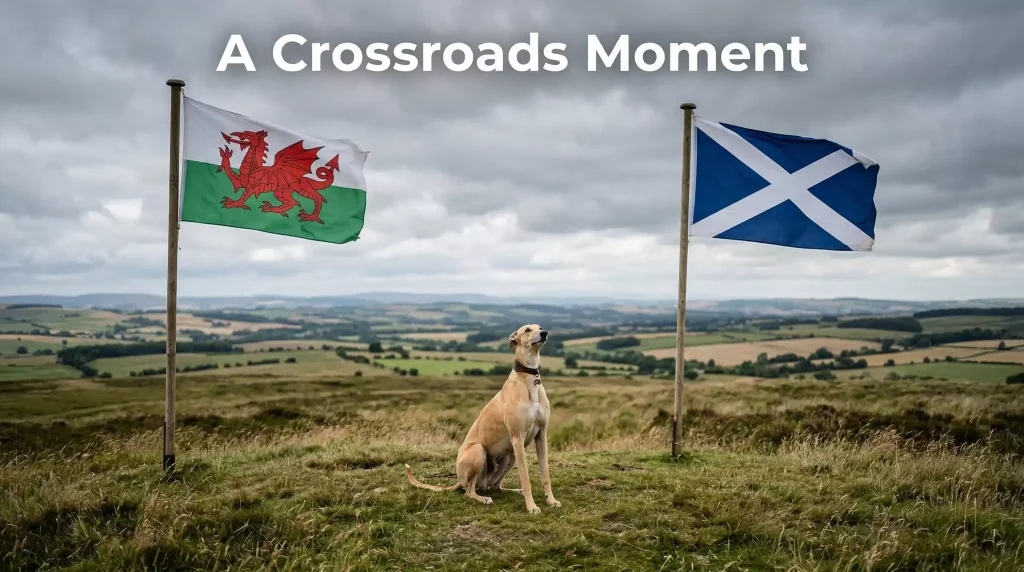
The greyhound racing ban is no longer a hypothetical discussion — it is legislative reality in one part of the UK and active political process in another. Wales voted to prohibit greyhound racing in December 2026, and Scotland introduced its own bill earlier the same year. Together, the two initiatives represent the legislative frontier of a debate that has been building for years, and their implications reach far beyond the borders of the nations that proposed them.
England, where all 18 currently licensed GBGB stadiums are located, has not introduced equivalent legislation. But the precedent set by Wales and Scotland changes the political landscape for the entire UK sport. This article covers what each nation has done, what the public thinks, and what the devolved bans mean for the future of greyhound racing in England.
The welfare data behind the debate is in welfare in racing.
The Wales Ban — How the Senedd Voted and What Happens Next
On 16 December 2026, the Senedd (Welsh Parliament) voted 36 to 11, with three abstentions, in favour of the general principles of the Prohibition of Greyhound Racing (Wales) Bill. The vote was decisive — a margin of more than three to one — and cleared the first major legislative hurdle in the bill’s passage. The ban is expected to come into effect no earlier than 1 April 2027 and no later than 1 April 2030, giving the industry a transition window to wind down operations.
Wales currently has one licensed greyhound stadium: Valley Stadium, the sole GBGB-licensed track in the country. When the ban takes effect, Valley Stadium will close, and Wales will become the first UK nation to outlaw greyhound racing entirely. The practical impact on the national circuit is limited — one track out of 18 — but the symbolic impact is substantial. A UK parliament has looked at the evidence, debated the arguments, and concluded that the sport should not continue within its jurisdiction.
The industry’s response was sharp. GBGB chief executive Mark Bird described the vote as “neither good government nor good politics,” arguing that “Wales is sleepwalking into the arms of an animal rights future that no one has voted for” (Dogs Today Magazine, 2026). The criticism reflected the industry’s broader frustration with what it sees as a legislative agenda driven by campaign groups rather than a balanced assessment of the sport’s welfare record.
Wales’s Deputy First Minister Huw Irranca-Davies took the opposite view, framing the bill as a matter of animal protection: “It is about protecting the lives and welfare of greyhounds in Wales. Greyhound racing around a track poses an inherent risk of high-speed collisions, falls and injuries” (Dogs Today Magazine, 2026). That position places the risk itself, rather than the management of that risk, at the centre of the case for prohibition.
Scotland’s Greyhound Racing Bill — Where It Stands
In April 2026, Mark Ruskell MSP introduced the Greyhound Racing (Offences) (Scotland) Bill to the Scottish Parliament, proposing a ban on greyhound racing on oval tracks in Scotland. The bill’s scope is specific: it targets the format used by licensed stadiums, where dogs race around a track in pursuit of a mechanical lure. Scotland has no GBGB-licensed stadiums — the last one closed years ago — but it does have independent tracks operating outside the GBGB regulatory framework.
The Scottish Animal Welfare Commission published a report on greyhound welfare at Thornton, the only independent track then operating in Scotland. The data from that report was striking: across 569 recorded runs, there were 2 serious injuries and 1 fatality, producing an injury rate of 0.35 per cent and a fatality rate of 0.176 per cent — both significantly higher than the rates recorded at GBGB-licensed stadiums in England, where the injury rate stood at 1.07 per cent and the fatality rate at 0.03 per cent in 2026. The Thornton data highlighted the gap between licensed and unlicensed racing, and provided ammunition for those arguing that the sport poses inherent risks that regulation alone cannot eliminate.
The Scottish bill remains in the legislative process and has not yet been voted on at the time of writing. Its progress will depend on the political dynamics within the Scottish Parliament and the weight of evidence presented by both supporters and opponents during the committee stages.
What the Public Thinks — Polling Data
Public opinion surveys have provided a consistent backdrop to the legislative moves in both nations. Panelbase polls, commissioned by the campaign group GREY2K between 2022 and 2023, found that 57 per cent of Welsh respondents and 60 per cent of Scottish respondents supported ending greyhound racing. Petitions in both countries broke records: more than 35,000 signatures in Wales and 28,000 in Scotland, the highest totals for any petition in their respective parliaments at the time.
These figures should be read with context. The polls were commissioned by an organisation that actively campaigns for the abolition of greyhound racing, and polling methodology — question framing, sample selection — can influence results. The petition numbers, while impressive, represent a small fraction of the total electorate in either country. Supporters of the sport argue that public opinion is shaped by campaigning rhetoric and selective use of welfare data, rather than a comprehensive understanding of how the sport operates under GBGB regulation.
Regardless of the methodological debates, the political reality is that elected representatives in both Wales and Scotland have treated the polling data as a mandate to act. The votes and bills that followed were not introduced into a vacuum — they were responses to a measurable shift in public sentiment, however that sentiment was formed.
The wider context is set out in tonight’s greyhound results.
What Wales and Scotland Mean for English Racing
England is where the sport lives. All 18 GBGB-licensed stadiums are in England. The BAGS schedule, the SIS fixture list, the voluntary levy, the welfare infrastructure — everything that constitutes the operational reality of UK greyhound racing is concentrated south of the Scottish border and east of the Welsh one. In strict practical terms, the Welsh and Scottish bans affect one active stadium and a handful of independent tracks.
The precedent, however, is harder to contain. If two of the UK’s three devolved parliaments conclude that greyhound racing should be prohibited, the question of whether England should follow becomes increasingly difficult for Westminster politicians to avoid. Campaign groups have already signalled their intention to pursue English legislation, and the Welsh vote gives them a template: build public support, commission polls, generate petitions, and present the case to parliamentarians who may be sympathetic.
The industry’s best defence is its data. GBGB has invested heavily in welfare transparency since 2018, publishing injury and retirement figures that show improving trends across most measures. The argument from the GBGB side is that the sport is reforming itself, that the data shows measurable progress, and that prohibition is a disproportionate response to problems that regulation can address. Whether that argument is sufficient to prevent English legislation remains to be seen. The legislative frontier has moved, and the sport’s future in the UK may depend on whether the progress it has made is enough to keep the line where it currently stands.
