
Greyhound Racing Glossary — 60+ Key Terms for Betting, Form and Results
 Available in US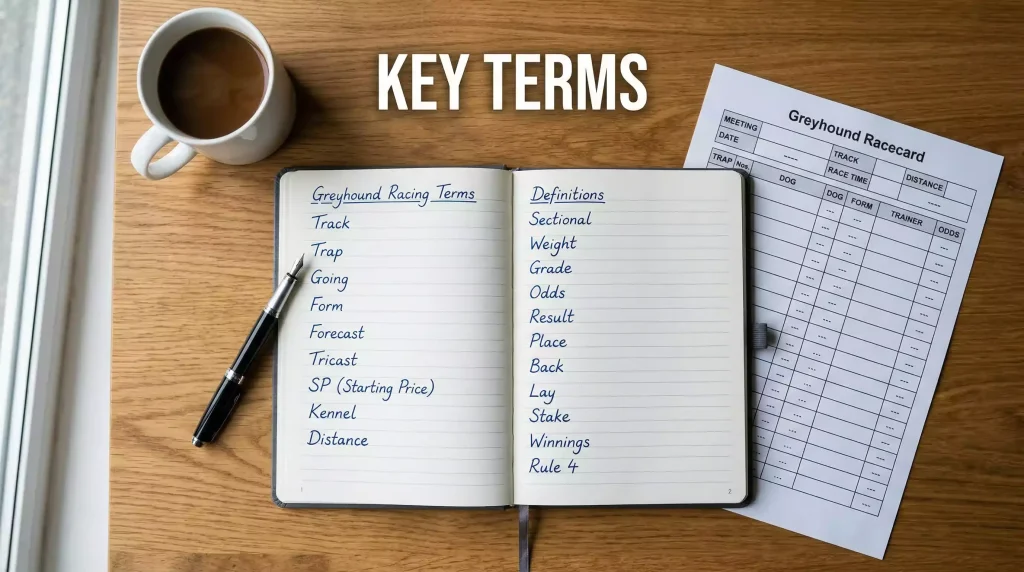
Greyhound racing has a vocabulary all its own — a mix of racing shorthand, betting jargon, and administrative acronyms that can leave newcomers staring at a results page as if it were written in code. Every term explained here is one you will encounter on racecards, in results tables, or in conversation with anyone who follows the sport. Some are shared with horse racing; others are specific to the dogs. All of them are worth knowing if you want to move from passive spectator to informed bettor.
This glossary covers the core terms across three categories: racing (what happens on the track), betting (what happens with your money), and administration (the organisations and systems that run the sport). It is not exhaustive — greyhound racing has more niche terminology than any single glossary can capture — but it covers every term you are likely to need in your first year of following the sport seriously.
The terms in use appear on the racecard.
Racing Terms — From Going to Sectional Time
Going describes the condition of the track surface at the time of racing. Common declarations include “normal” (standard conditions), “slow” (heavier surface, usually after rain), and “wet fast” (damp but firm). The going affects finishing times across the entire card and should be factored into any comparison between runs at different meetings.
Sectional time is the split time for a portion of the race, usually the opening section from traps to the first timing point. Sectional times reveal whether a dog is a fast trapper or a slow starter, and how its pace changes through the race. A quick opening sectional followed by a slow closing sectional indicates a front-runner that fades; the reverse suggests a closer.
Running line describes the path a dog takes around the track. A rail runner stays close to the inside rail; a wide runner drifts out through the bends. Running line is noted in race comments and affects how much ground a dog covers relative to its rivals.
Bend refers to the four turns on a standard oval track. Greyhound tracks have four bends, and a dog’s ability to handle them without losing ground or position is critical. “Baulked second bend” in a race comment means the dog was interfered with on the second turn.
Trap is the starting box, numbered 1 (inside) to 6 (outside), each with a corresponding jacket colour. The trap determines the dog’s starting position and its proximity to the rail on the first bend.
Grade is the classification assigned to a dog based on its recent performance, ranging from A1 (highest) to A11 (lowest). Grades determine which races a dog enters and ensure competitive balance within each race.
Non-runner is a dog that was entered in a race but did not start, usually due to injury, illness, or a trainer’s decision to withdraw. Non-runners are removed from the betting market, and their absence can affect the trap draw if the vacated position is not reassigned.
Photo finish occurs when two or more dogs cross the line so close together that the naked eye cannot separate them. The electronic timing system and photo-finish camera determine the official order, and the result may be delayed by a minute or two while the image is reviewed.
Winning distance measures the gap between finishers, expressed in lengths (one length equals roughly one dog’s body length). Common descriptions include “short head” (almost inseparable), “neck,” “one length,” and “distance” (a wide margin).
Betting Terms — SP, BSP, Forecast, Tricast and More
SP (Starting Price) is the official odds of a dog at the moment the traps open, determined by the on-course betting market. Bets placed at SP are settled at whatever price is returned.
BSP (Betfair Starting Price) is the price generated by the Betfair exchange at the start of the race, based on matched back and lay orders. BSP can differ from SP, sometimes significantly on longer-priced runners.
Forecast is a bet predicting the first and second finishers in exact order. A straight forecast names both positions; a reverse forecast covers both orderings; a combination forecast covers all possible pairings from three or more selections.
Tricast is a bet predicting the first, second, and third finishers in exact order. A combination tricast covers all orderings of three or more selections. Tricast dividends tend to be substantially higher than forecasts because of the added difficulty.
CSF (Computer Straight Forecast) is the calculated dividend for a forecast bet, generated by a mathematical formula based on the SPs of the first two finishers. It is the standard method used by off-course bookmakers.
Each-way is a bet split into two parts: a win bet and a place bet. In greyhound racing, the place portion typically covers the first two finishers, paying at a fraction (usually one quarter) of the win odds.
Accumulator is a bet combining multiple selections across different races, where the winnings from each successful leg roll onto the next. All selections must win for the accumulator to pay.
Tote (Totalisator) is a pool betting system where all stakes are combined, a deduction is taken, and the remainder is divided among winning bettors. Tote dividends are not known until after the race.
The language of betting in greyhound racing can be unfamiliar to newcomers, particularly those entering the sport from other gambling backgrounds. With inflation-adjusted betting turnover on greyhounds having fallen by 23 per cent over the three years to March 2026, according to Gambling Commission data reported by Racing Post, the sport is aware that making its terminology accessible is part of attracting and retaining a broader audience.
The wider context is set out in tonight’s greyhound results.
Administrative Terms — GBGB, BAGS, SIS, BGRF
GBGB (Greyhound Board of Great Britain) is the governing body for licensed greyhound racing in the UK. It sets the rules, manages the grading system, licenses tracks and trainers, and publishes welfare and injury data. All 18 currently active UK stadiums are GBGB-licensed.
BAGS (Bookmakers Afternoon Greyhound Service) is the system through which the majority of daily greyhound fixtures are organised and funded. Despite the name, BAGS fixtures now run morning, afternoon, and evening. The system connects stadiums with bookmakers, ensuring a continuous supply of live racing content.
SIS (Sports Information Services) is the data and media company that distributes greyhound racing content to bookmakers and broadcasters. SIS delivers a minimum of 42 fixtures every week, with contracts covering major operators including bet365, William Hill, Paddy Power, and Betfred.
BGRF (British Greyhound Racing Fund) collects and distributes the voluntary levy — a 0.6 per cent charge on greyhound betting turnover paid by bookmakers. The BGRF income funds welfare initiatives, prize money, and the administrative infrastructure of the sport. As GBGB chief executive Mark Bird has noted, the levy percentage has not changed since 2009, and the income it generates has declined steadily as overall betting turnover has fallen — a pressure point that the industry continues to debate.
The Racing Partnership is a consortium that holds media rights for a group of greyhound tracks, operating alongside SIS in the fixture scheduling ecosystem. Its addition to the BAGS schedule in 2018 expanded the weekly fixture list from around 46 meetings to up to 74.
Gambling Commission is the UK regulatory body overseeing all gambling activity, including greyhound betting. It licenses bookmakers, publishes industry statistics, and sets the regulatory framework within which the sport’s betting market operates. The Commission does not regulate the racing itself — that is GBGB’s role — but its oversight of the betting side shapes the commercial environment in which greyhound racing exists.
