Greyhound Racing History in the UK — From 75 Million Spectators to 18 Tracks
 Available in US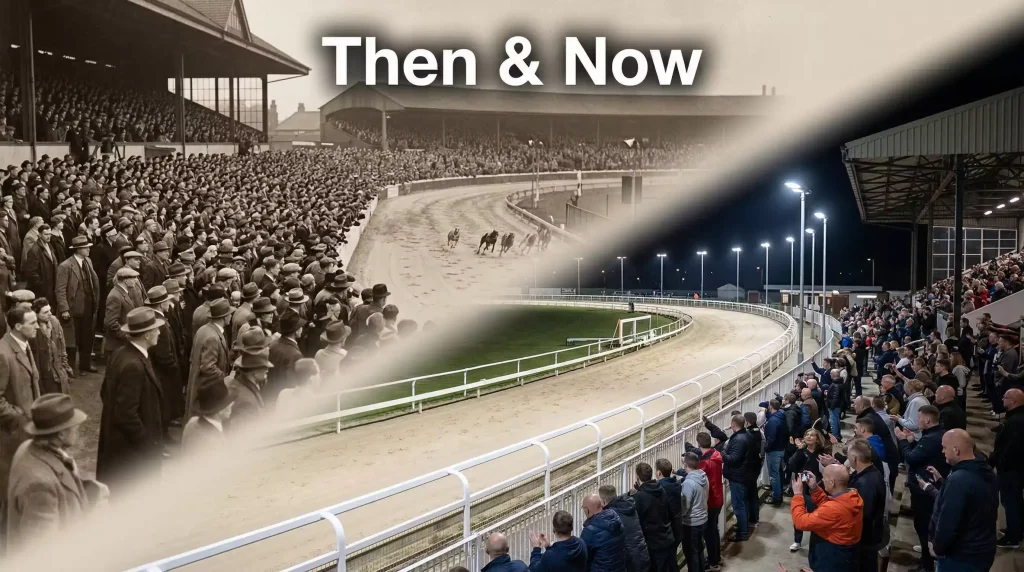
The history of greyhound racing in the UK is a century on the track — from a single experimental meeting in Manchester in 1926 to a sport that, at its peak, drew 75 million spectators a year and sustained 77 licensed stadiums across Britain. In 2026, the circuit has contracted to 18 tracks, the crowds have thinned to a fraction of their post-war highs, and the sport finds itself navigating legislative threats, declining betting turnover, and a public image that swings between affection and controversy. But it is still here. A hundred years after the first dogs chased a mechanical lure around an oval track, greyhound racing remains part of the British sporting fabric — changed beyond recognition, but not yet gone.
Understanding where the sport has been is essential context for understanding where it is now. The story moves through three distinct phases: the explosive birth and rapid growth, the golden age and the long decline that followed, and the modern era of BAGS racing, digital betting, and welfare reform that defines the sport today.
What remains of that estate is in the tracks guide.
1926 — Belle Vue and the Birth of British Greyhound Racing
The first modern greyhound race in Britain took place at Belle Vue Stadium in Manchester on 24 July 1926. The event used a mechanical lure — an electric hare running on a rail around an oval track — to replicate the ancient sport of hare coursing in a controlled, spectator-friendly environment. The concept had been imported from the United States, where the first oval-track greyhound race had been staged in Emeryville, California, in 1919, and its arrival in Britain coincided with a population hungry for affordable entertainment.
The sport expanded with extraordinary speed. Within months of the Belle Vue meeting, new stadiums were opening in London, Birmingham, Glasgow, and cities across the industrial heartlands. White City Stadium in London became the sport’s most iconic venue, attracting huge crowds and establishing greyhound racing as a mainstream evening entertainment — the working man’s alternative to horse racing, which remained a daytime, largely middle-class pursuit. The appeal was simple: an evening at the dogs cost less than a night at the cinema, lasted two hours, and came with the added excitement of a flutter on the result.
By the late 1920s, dozens of stadiums were operating across Britain. The introduction of the totalisator — a mechanical betting pool that allowed on-course wagering in a regulated format — gave the sport a financial infrastructure that supported its growth. By January 1947, there were 77 licensed greyhound tracks in Britain, including 15 in London alone, where the major stadiums regularly attracted 30,000 to 40,000 spectators on a Saturday evening. The annual attendance figure for 1946 was estimated at 75 million — a number that reflected the extraordinary position greyhound racing held in British social life during the immediate post-war years.
The wider context is set out in tonight’s greyhound results.
The Golden Age and the Long Decline
The late 1940s represented the sport’s zenith. Greyhound racing was the second most attended spectator sport in Britain after football, and its stadiums were social hubs for communities that had few other affordable evening entertainment options. The totalisator turnover for 1946 reached £196 million — a vast sum in post-war pounds — and the sport generated tax revenue that the government was keen to protect.
The decline began in the 1950s and accelerated through the 1960s, driven by forces that no amount of track management could counteract. Television arrived in British homes and offered an alternative to the evening outing. The legalisation of off-course betting shops in 1961 meant that punters could place bets without visiting a stadium, removing one of the primary reasons for attendance. Car ownership increased, expanding the range of leisure options available to working-class families, and the urban neighbourhoods that had sustained stadium crowds began to disperse as suburban housing replaced inner-city terraces.
Track closures followed the attendance curves. The 77 stadiums of 1947 shrank to fewer than 40 by the 1980s, and the contraction continued relentlessly through the 1990s and 2000s. Iconic London venues closed one by one: White City in 1984, Hackney Wick in 1997, Wimbledon in 2017. Each closure removed a piece of the circuit and concentrated the surviving sport into a smaller number of venues. By 2026 — the centenary year — the circuit had contracted to 18 licensed stadiums, with three further closures (Crayford, Perry Barr, Swindon) partially offset by the opening of Dunstall Park in Wolverhampton.
The decline was not uniform. While attendance collapsed, betting on greyhound racing shifted from on-course to off-course and, later, to online platforms. The sport lost its crowds but retained its betting audience — a dynamic that BAGS racing was designed to exploit. The greyhound stadium as a social venue was in terminal decline; the greyhound race as a betting product proved more durable.
Modern Greyhound Racing — BAGS, Digital Betting, and Today
The BAGS system — the Bookmakers Afternoon Greyhound Service — transformed the economics of UK greyhound racing by decoupling the sport from its dependence on gate receipts. Under BAGS, stadiums are paid to run fixtures that are distributed to betting shops and online platforms, creating a revenue stream based on broadcast and data rights rather than turnover at the track gate. The system expanded dramatically after 2018, and it now sustains up to 74 meetings per week across the licensed circuit.
The shift to digital betting has further reshaped the landscape. Online bookmakers offer greyhound markets alongside football, horse racing, and casino products, and punters can watch live streams and place bets without leaving their homes. The global greyhound racing market was valued at approximately $2.1 billion in 2026, with projections of growth to $2.8 billion by 2033, according to Market Research Intellect. The UK remains one of the largest national markets, though its share of the global total has diminished as racing in Australia and Ireland has grown.
The modern sport also operates under a welfare spotlight that would have been unimaginable to the founders at Belle Vue. GBGB publishes annual injury and retirement data, the Injury Recovery Scheme provides veterinary support for career-ending injuries, and the rehoming infrastructure has expanded to handle thousands of retired dogs each year. Lisa Morris-Tomkins, chief executive of the Greyhound Trust, has argued that “the number of racing greyhounds who never have the opportunity to experience a loving home when their racing career is over is unacceptable, and the base line injury and retirement figures published must be improved” (Greyhound Trust). Her words capture the tension at the heart of modern greyhound racing: a sport that has made measurable progress on welfare while facing persistent criticism that the progress is not enough.
A century on the track has taken greyhound racing from 75 million spectators and 77 stadiums to 18 tracks and a betting audience that increasingly watches from a screen rather than a grandstand. The sport has survived by adapting — to television, to betting shops, to BAGS, to digital platforms — and its continued existence depends on whether it can adapt once more to the demands of a public and a political class that are asking harder questions than ever about whether the dogs should be running at all.
