
Greyhound Trap Bias Statistics — Data on How Starting Position Affects Results
Best Greyhound Betting Sites – Bet on Greyhounds in 2026
Loading...
Greyhound trap bias statistics reveal one of the most consistent and least discussed edges in UK dog racing. The starting position — which trap a dog breaks from — affects its chances of winning in ways that are measurable, repeatable, and, in many cases, predictable. Yet most casual bettors treat the trap draw as a cosmetic detail, a colour-coded jacket number rather than a factor that should influence their selection.
The numbers behind the draw tell a different story. Aggregated across UK tracks, some traps win significantly more often than probability would suggest, and the pattern is not random. It is rooted in physics: the geometry of the track, the position of the first bend relative to the starting boxes, and the biomechanics of a dog running at full speed along a rail or across open ground. Understanding trap bias does not guarantee winners, but ignoring it is the equivalent of studying a football match without checking the team sheet. The data is there. It costs nothing to read it.
Aggregate Trap Bias Across UK Tracks
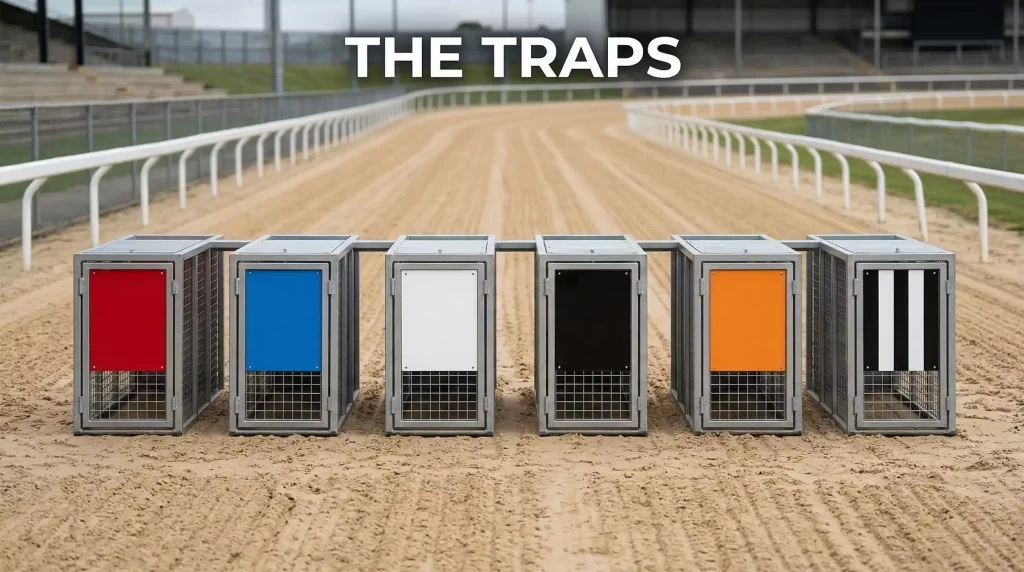
In a perfectly even six-trap race, each starting position would win approximately 16.6 per cent of the time — one in six. The real numbers are different. Aggregated data from across UK tracks shows that Trap 1 — the innermost box, marked with a red jacket — wins at roughly 18 to 19 per cent, consistently above the theoretical baseline. That two to three percentage point edge may sound modest, but over hundreds of races it translates into a meaningful statistical advantage that shapes how the entire market prices inside-drawn runners.
The explanation is mechanical rather than mystical. A dog breaking from Trap 1 has the rail on its immediate left and only needs to defend against pressure from one side — the right. It has the shortest path to the first bend, because the inside line around any turn is geometrically shorter than the outside line. And in the chaos of the opening strides, when six dogs are accelerating from a standing start towards the same piece of track, the dog on the inside has a natural barrier protecting its flank.
The advantage does not decline evenly as you move outward. Trap 2 typically wins at close to the theoretical 16.6 per cent, and Traps 3 and 4 hover around or slightly below that figure. Trap 5 shows a marginal recovery at some tracks, because a dog drawn in 5 has room to angle towards the rail before the first bend without being blocked by the inside runners. Trap 6 — the widest box — has the most variable record, and this is where the aggregate data becomes less useful than the track-specific figures, because the performance of Trap 6 depends heavily on the geometry of the individual circuit.
It is worth pausing on what the aggregate data does not show. The 18 to 19 per cent figure for Trap 1 is a blend of all UK tracks, all distances, and all race types. Within that blend, there are tracks where Trap 1 wins at 22 per cent and tracks where it wins at 15 per cent. The aggregate is a starting point — useful for understanding the general principle, but too blunt an instrument for race-by-race analysis. For that, you need track-specific data.
Trap Bias Varies by Track — Examples
The variation between tracks is where trap bias statistics become genuinely useful — and occasionally surprising. Data compiled from UK greyhound form databases shows that at some venues, the pattern deviates dramatically from the national average.
At Wimbledon — before its closure — historical data showed that 43.69 per cent of winning favourites came from Trap 6, the widest starting position. Trap 1, the supposed inside advantage, produced just 38.53 per cent of favourite winners. This inverted the expected pattern entirely. The explanation lay in Wimbledon’s track geometry: the run from the traps to the first bend was configured in a way that gave wider-drawn dogs a clean path to the rail without the congestion that typically disadvantages outside runners at other venues.
Harlow presented an even more extreme case, with 47.12 per cent of winning favourites breaking from Trap 6. At a track where nearly half of all favourite wins come from the widest box, any bettor applying a generic “inside is best” rule would be systematically backing the wrong trap. Kinsley, by contrast, showed a much flatter distribution, with Trap 6 producing just 21.84 per cent and Trap 1 recording 23.12 per cent — a track where trap draw was less influential and other factors, such as raw pace and form, played a relatively larger role.
These examples illustrate a principle that applies across the entire UK circuit: trap bias is real, but it is local. The aggregate figures give you the direction — inside traps tend to have an advantage — but the specific magnitude and even the direction of that advantage depends on the track. A dog drawn in Trap 6 at one venue is in a fundamentally different position from a dog drawn in Trap 6 at another, and the results data confirms this consistently.
The practical challenge is access. Track-specific trap bias data is not always easy to find in one place. Some form services publish it, others do not. Compiling your own from results archives — counting wins by trap across a few hundred races at a single track — is time-consuming but not difficult, and the patterns tend to stabilise after a relatively small sample. A hundred races at one track is usually enough to see whether Trap 1 is genuinely dominant or whether the local geometry produces a different story.
How to Use Trap Bias in Race Analysis
Trap bias is most useful when combined with other form factors rather than used in isolation. Knowing that Trap 1 wins 20 per cent of races at a particular track is a starting point; knowing that the dog in Trap 1 tonight also has strong recent form over this distance and has shown early pace in its last three runs makes the insight actionable.
The combination works in three layers. First, check the trap bias data for the specific track and distance. A track might show inside bias at 480 metres but a more neutral pattern at 660 metres, because the longer run to the first bend at the stayers’ distance gives outside runners more time to find position. Second, overlay the dog’s running style. A dog that habitually leads from the front benefits more from an inside draw than a dog that settles in midfield and finishes late — the latter will often find a way to the rail by the second bend regardless of where it started. Third, factor in the going. Heavier going tends to slow the pace of the opening strides, which can reduce the significance of trap draw because dogs have more time to adjust their positions before the first bend.
The funding and data infrastructure behind this analysis is worth a brief note. GBGB’s chief executive Mark Bird has spoken about the financial pressures facing the sport: “Since the GBGB began operating in 2009, there’s been no increase in the percentage that’s being paid, which is 0.6% of greyhound turnover. What that has meant is that the amount year-by-year has steadily gone down” (Gambling Insider). The availability of published data, from injury statistics to race results, depends in part on the resources the sport has to collect and distribute it. Trap bias data is a byproduct of that broader data ecosystem, and its accessibility is a function of how well funded the sport’s information infrastructure remains.
For the individual bettor, the takeaway is straightforward. Trap bias statistics are free, they are derived from publicly available results, and they provide a structural advantage that most of the market underweights. The numbers behind the draw will not pick your winners for you, but they will tell you which runners have the geometry in their favour before the traps open — and in a sport where margins are measured in lengths and tenths of a second, that information is worth having.