Newcastle Greyhound Results — Brough Park Races, All England Cup and More
Best Greyhound Betting Sites – Bet on Greyhounds in 2026
Loading...
Newcastle greyhound results come from Brough Park, the north-east’s flagship greyhound stadium and one of the most improved venues in the country. Situated in the Byker area of Newcastle upon Tyne, Brough Park has been racing greyhounds since 1928, which makes it one of the oldest active tracks in Britain. But the story here is not about history alone — it is about what has happened recently, and the numbers point firmly upward.
Brough Park is an Arena Racing Company venue, and it has benefited from ARC’s broader investment in the greyhound circuit. The results are visible in both the facilities and the attendance figures: Newcastle has recorded some of the most striking growth numbers in UK greyhound racing, with crowds at its biggest events climbing sharply at a time when many leisure and sporting venues are struggling to maintain footfall.
Results from Newcastle follow the same GBGB-standard format as every other licensed track: finishing positions, times, SPs, forecast and tricast dividends, race comments, and going. What sets Brough Park nights apart is the combination of competitive racing, a growing audience, and a signature event — the All England Cup — that gives the stadium a profile beyond its regular fixture list.
Brough Park — Distances, Surface, and What to Know
Brough Park’s circuit is a standard oval with four bends, offering racing over multiple distances. The programme covers sprint trips, the standard distance of approximately 480 metres, and stayers’ races that test endurance over longer distances. The standard trip is the most commonly run, forming the backbone of the evening card, but Brough Park’s longer races are well supported and draw a good quality of dog — the track’s generous proportions make it a fair test over extended distances.
The bends at Brough Park are moderately wide, which gives the track a more open character than tighter circuits in the south and Midlands. This geometry benefits dogs that run with a wide, sweeping action as well as those that hug the rail, creating a more balanced competitive environment where trap draw is less decisive than at compact venues. The run from the traps to the first bend is long enough to allow all six dogs to settle into their running positions before the first turn arrives, which generally produces cleaner racing with less first-bend interference.
The surface is sand-based, consistent with the rest of the UK circuit, and the stadium’s location in the north-east means that winter conditions can affect the going more frequently than at southern tracks. Cold evenings and damp air are part of the landscape at Brough Park from October through March, and the going declaration should be checked carefully before comparing times from different meetings. A “slow” going at Newcastle in January tells a different story from a “normal” going in July, and dogs that handle heavier conditions have a distinct advantage during the winter programme.
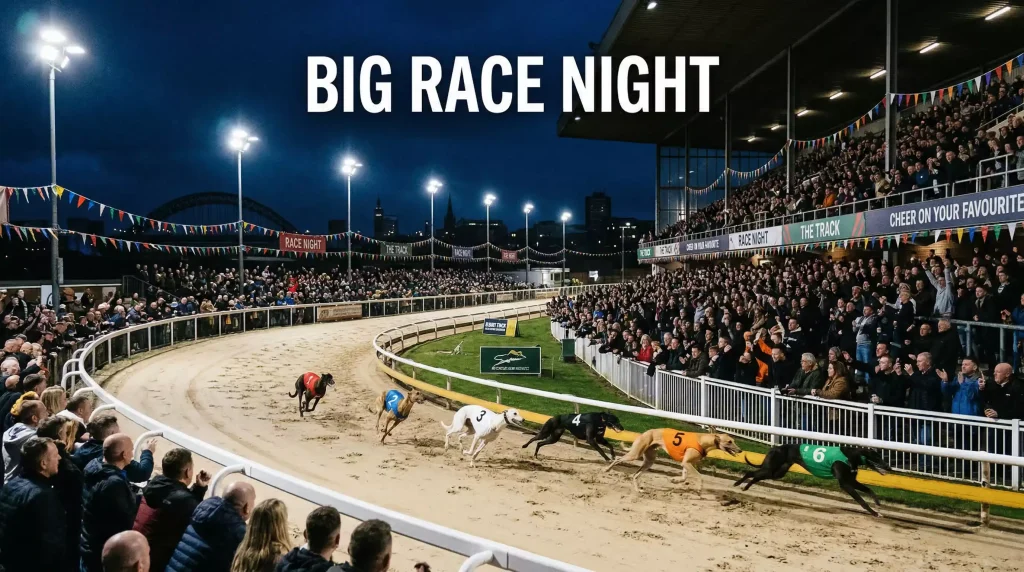
Race nights at Brough Park typically fall on selected weekday evenings and weekends, with the schedule coordinated through SIS to fit alongside meetings at other UK tracks. Each meeting runs the standard 12 races, providing a full evening of racing from approximately 19:00 to 22:00. The atmosphere on a well-attended evening is energetic — Brough Park has the feel of a venue where the crowd is genuinely engaged rather than simply present, and the noise level rises noticeably for the later races on the card.
Newcastle’s Attendance Boom
Newcastle’s attendance figures have been one of the standout stories in UK greyhound racing over the past two years. Arena Racing Company reported that Brough Park recorded an 85 per cent increase in attendance for the All England Cup finals, a figure that is remarkable by any standard in a sport that has been fighting a long battle against declining footfall at most venues.
That growth did not happen in isolation. ARC reported a 5 per cent overall increase in greyhound attendance across its venues in 2026, and Newcastle was one of the strongest contributors to that headline number. The combination of a well-promoted feature event, improved facilities, and a local audience that has responded to the investment has created a virtuous cycle: bigger crowds generate more atmosphere, which attracts more first-time visitors, which in turn makes the next event even more viable.
The context matters here. The Premier Greyhound Racing Oaks final at the newly opened Dunstall Park in Wolverhampton drew 324 per cent more spectators than the same event had attracted in its previous staging at Perry Barr — a jump that reflected both the novelty of a new venue and the pulling power of a flagship competition. Newcastle’s growth is arguably more significant, because it happened at an established track without the advantage of a grand opening. Brough Park grew its audience by improving what it already had, not by starting from scratch.
The practical implication for bettors is that Brough Park’s biggest meetings now carry a different atmosphere from its standard cards. The regular midweek fixture is a solid BAGS meeting with a core audience of regulars. The All England Cup rounds, and the occasional feature night, bring a larger crowd and a different energy that can affect the racing — more noise, more movement trackside, and dogs that may behave slightly differently in the traps or on the first bend. Whether this matters to results is debatable, but it is part of the context that serious form analysts note.
All England Cup — The Track’s Signature Event
The All England Cup is Brough Park’s signature competition and the event that has done the most to raise the stadium’s profile beyond the north-east. The Cup is an open-race event that attracts high-quality dogs from across the country, with heats, semi-finals, and a final staged over consecutive meetings. The format creates a narrative arc across several weeks — dogs progress through rounds, form lines develop, and the final becomes a genuine contest between proven performers rather than a one-off match race.
The prize money and prestige associated with the All England Cup make it a meaningful target for trainers with top-class dogs. While it does not carry the same purse as the English Greyhound Derby — where the winner collects £175,000 — the Cup offers a level of competition and public attention that elevates it well above the standard graded programme. For bettors, the All England Cup rounds provide some of the best racing available at Brough Park, with fields assembled on quality rather than grading convenience.
Sarah Newman, ARC’s marketing and communications manager, has observed that “competition for the leisure pound has never been higher, so to grow our footfall in 2026 is a great achievement” (Greyhound Weekly, 2026). The All England Cup at Newcastle is a case study in how a well-run event can draw people to a sport that many had assumed was in irreversible decline. The 85 per cent attendance increase for the Cup finals is not just a statistic — it is evidence that the product, when presented properly, still has pull.
For form purposes, All England Cup results should be read differently from standard graded cards. The class of dog competing is higher, the tactical racing is more intense, and the margins between runners are tighter. A dog that finishes third in an All England Cup semi-final has proven more about its ability than one that wins an A5 graded race on a quiet Tuesday. These form lines carry significant weight when the same dogs reappear in open races or feature events at other venues later in the season, and Brough Park nights during the Cup become some of the most valuable form-watching sessions of the year.