Nottingham Greyhound Results — Colwick Park Race Data and Meeting Updates
Best Greyhound Betting Sites – Bet on Greyhounds in 2026
Loading...
Nottingham greyhound results come from Colwick Park, the Midlands venue that has quietly built a reputation as one of the most well-attended and competitively programmed stadiums in the country. Situated on the eastern edge of Nottingham near the River Trent, Colwick Park is an Arena Racing Company venue that runs a regular fixture list and — at its best — draws crowds that rival anything outside of the flagship open-race calendar.
The stadium’s identity is shaped by two things: its track layout, which favours a particular style of racing, and its marquee events, which bring an atmosphere most BAGS fixtures rarely match. The annual Boxing Day meeting is the headline act, but Colwick Park under lights on a midweek evening has its own appeal — a reliable card of graded racing in a stadium that feels bigger and better maintained than its modest profile might suggest.
Results from Nottingham follow the same structure as every GBGB-licensed track: finishing positions, times, starting prices, forecast and tricast dividends, race comments, and going. What varies is the context those numbers sit within — and at Colwick Park, the context is shaped by the track’s distinctive shape, its generous bends, and a form book that rewards patience over raw speed.
Colwick Park — Distances, Track Shape, and Atmosphere
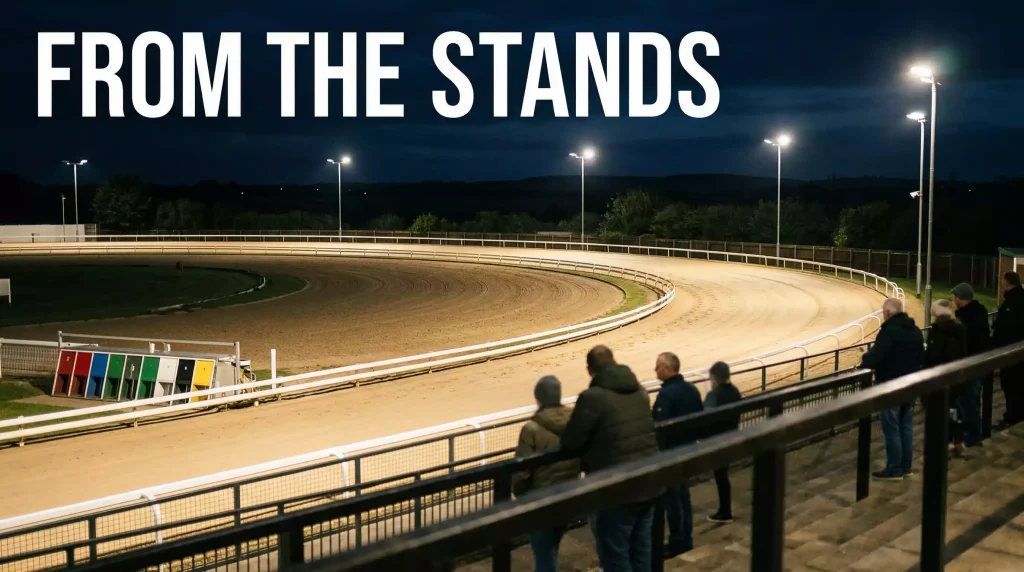
Colwick Park’s circuit is one of the larger in UK greyhound racing. The track is an oval with four bends, but the bends themselves are wider and more sweeping than those at tighter London venues like Romford. This geometry gives dogs more room to hold their line through the turns and reduces the penalty for running wide — which in turn affects trap bias and the types of running styles that prosper here.
Distances at Nottingham cover the standard range: sprint trips of around 305 metres, the bread-and-butter standard distance of roughly 500 metres, and stayers’ races of 680 metres or longer. The standard distance makes up the bulk of the evening programme, but Colwick Park’s stayers’ races are particularly well regarded, drawing dogs with genuine stamina rather than sprinters stretched beyond their natural range. The longer trip around those sweeping bends is a genuine test of sustained pace, and the results often sort themselves differently from the shorter races on the same card.
Race nights at Nottingham typically run on selected weekday evenings and weekends, slotted into the SIS-coordinated schedule alongside meetings at other BAGS tracks. A standard meeting runs 12 races at roughly 15-minute intervals, with the first race on an evening card usually going off between 18:30 and 19:00. The stadium has invested in its facilities over recent years, including improved lighting, refurbished grandstand areas, and a catering operation that makes an evening at the track feel like more than just a backdrop for betting.
The atmosphere at Colwick Park on a well-attended evening is noticeably different from the quieter daytime BAGS fixtures. Nottingham benefits from its location in a city large enough to provide a reliable local audience, and the stadium’s facilities are good enough to attract people who might otherwise spend their evening elsewhere. It is not uncommon to see families, groups of friends, and couples alongside the regulars — a mix that gives the venue a social character that some of the smaller, more utilitarian tracks struggle to replicate.
Boxing Day and Nottingham’s Biggest Meetings
Nottingham’s Boxing Day fixture is the stadium’s signature event, and it has become one of the best-attended meetings on the entire UK greyhound calendar. Arena Racing Company reported that the 2026 Boxing Day meeting at Colwick Park drew more than 1,000 spectators — the largest crowd at the stadium in recent years and a figure that underlines how a well-promoted fixture at the right time of year can generate genuine buzz around greyhound racing.
The appeal of the Boxing Day card is partly seasonal — it falls on a day when people are looking for something to do outside the house, and an evening at the dogs fits the bill — and partly structural. The meeting is typically stacked with competitive races, including higher-graded events and sometimes invitational or open-race contests that attract quality dogs from outside the stadium’s usual pool of runners. Prize money is often enhanced, which in turn draws better entries and produces closer finishes.
Beyond Boxing Day, Nottingham hosts periodic open races and feature events throughout the year. These do not carry the national profile of the English Greyhound Derby or the Oaks, but they serve an important function in the calendar: they give top dogs in the Midlands a competitive outlet without requiring a trip to the major championship tracks, and they provide bettors with higher-quality racing than the standard graded card.
The success of events like the Boxing Day fixture reflects a broader trend. Nottingham is not trying to be the biggest or the most famous — it is building an identity as a track that delivers a quality evening out, consistently, with the occasional standout meeting that draws a wider audience. The results from those big nights are worth studying separately, because the class of racing is markedly higher than on a standard Tuesday evening, and the form lines carry different weight.
Common Form Trends at Nottingham
Nottingham’s wider bends and longer straights create form trends that differ meaningfully from tighter-circuit tracks. The most obvious pattern is that early pace, while still an advantage, is less decisive here than at venues where the first bend comes up quickly. Dogs that are moderate trappers but strong through the middle of a race — the ones that gain ground on the second and third bends — tend to perform better at Colwick Park than their raw recent form might suggest.
This has implications for trap bias. Across UK greyhound racing as a whole, Trap 1 wins at approximately 18 to 19 per cent of the time, above the theoretical 16.6 per cent that would apply if all starting positions were equal. At Nottingham, the inside advantage still exists, but it is less pronounced than at tracks with sharper turns. The wider geometry gives outside runners more room to compete, which means that dogs drawn in Trap 5 or Trap 6 are not as heavily penalised as they would be at a compact venue. If you are assessing tonight’s Colwick Park card, do not discount a dog purely because it has drawn wide — check its running style first.
Going conditions at Nottingham can vary more than at some stadiums, partly because of the venue’s proximity to the River Trent and the local climate. A wet day can leave the surface heavier than usual, and when that happens, times across the card will drift upward. Dogs that handle softer going — typically those with a powerful, ground-covering stride rather than a light, skimming action — come into their own on those evenings. Comparing a dog’s recent Nottingham times without accounting for the going is one of the most common errors in form analysis, and it is easy to avoid: the going is published before racing and recorded in every set of results.
Stayers’ form at Colwick Park deserves particular attention. The 680-metre trip is a genuine endurance test, and the results over this distance often reveal more about a dog’s underlying fitness and racing intelligence than the standard-distance results on the same card. A dog that finishes strongly over 680 metres at Nottingham is telling you something about its condition that a mid-table finish over 500 metres might not. If that dog is then entered over the shorter distance at its next outing, the stayers’ run provides context that the standard form figures alone cannot offer.